
For the last couple of years my landscape photography hikes have typically included both daytime and nighttime objectives and a heavy kit of prime lenses to support the night work. I typically carry an ultrawide f2.8 and the Sigma 35mm f1.4 Art specifically for nightscapes. There’s never been a zoom option that I thought I’d be happy with. I’ve almost pulled the trigger a couple times on the Nikon 14-24mm but filter mounting issues (for daytime use) always scared me off. Since we’re actually getting a rainy season in California this winter, I’ve been shooting in inclement weather more than usual and appreciating being able to cover a lot of situations with a single weather-sealed zoom lens.
The new version III of the Canon 16-35mm f2.8L caught my eye recently. Lens Rentals bench tests showed great resolution performance and Lens Tip testing indicated good handling of coma/astigmatism at the wide end. Coma control is not exactly stunning in the corners at 24mm/35mm, but it looks like it could be an acceptable compromise in some situations. And it accepts standard filters. So the new Canon has a lot of things going for it. During the day and in bad weather I’d be able to do most of my shooting with a single lens, as long as I’m willing to give up my usual 24mm tilt shift. That 24mm tilt shift isn’t great at night, so I’m not losing anything there, and I’d have a hard time leaving my Sigma 35 at home anyways — f1.4 is a huge advantage at night. Typically then, I’ll only drop one lens from my kit with the zoom option, but the weather resistance would be an important advantage in bad weather. Having convinced myself that I needed the new Canon 16-35mm, I made the purchase and allowed myself a short window to compare it to a couple other 16-35’s that I had on hand at the time: the Canon 16-35mm f4L IS and the Sony/Zeiss FE 16-35mm f4.
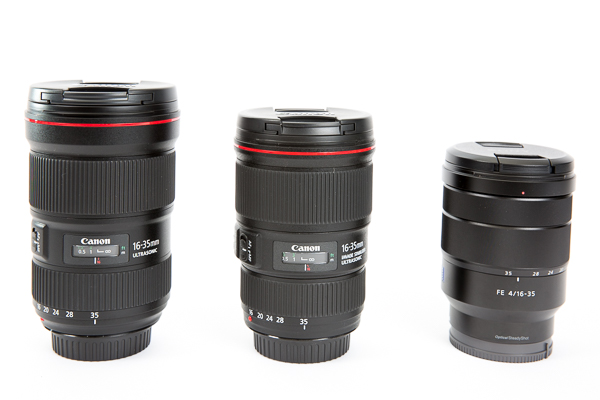
From left to right: Canon f2.8L III, Canon f4L IS, Sony/Zeiss f4.
There are plenty of people out there with sophisticated bench testing rigs and you should read their reports. I did some quick and dirty testing trying to evaluate how their results would translate into real world images using my copies of the lenses. I make no claims of a thorough or complete review; there are numerous deficiencies in my methodology. But I still find my results informative. All images were shot on a Sony A7RII. Canon lenses used a Metabones Mark IV adapter. All properly manufactured/adjusted modern lenses do just fine in the center, so I’ll only concern myself with the corners. I compare 100% crops, and each lens was manually focused on the cropped area, showing the best corner performance you can obtain at the given aperture.
Near Focus
First, let’s look at near focus corner performance. If I’m worried about near field focus I’m usually going to be shooting at small apertures, so I only looked at f8. Here’s the test subject at 16mm.

Near focus test subject.
At 16mm the version III Canon does indeed show a useful improvement over the other two lenses. Though I wasn’t really looking for it, the Canon f4L does show some chromatic aberration.

16mm, close focus
At 24mm, the Sony again brings up the rear, but a slight advantage may go to the Canon f4L.

24mm, close focus
At 35mm the Canon f2.8L III is clearly significantly stronger than the others.

35mm, close focus
I wouldn’t say any of these lenses are horrible here on the high resolution 24MP A7RII sensor, but the Canon 2.8 III is the clear winner in the near field.
Far Focus
For far focus, I looked at corner performance at both f8 and f4. Here’s the test subject at 16mm.

Far focus test subject.
At 16mm the Canon f4 shows pronounced chromatic aberrations. This is better controlled in the Canon f2.8 and the Sony, with the Canon f2.8 taking an edge in resolution and contrast.

Far focus, 16mm f8.0
At 24mm the differences are minimal. Maybe a bit better microcontrast for the Canons, particularly for the f2.8, although the exposure differences may be at play here (cloud cover was variable while I was shooting the test images).

Far focus, 24mm f8.0
At 35mm the Canon f2.8 and the Sony look pretty good. The Canon f4L is a bit soft.

Far focus, 35mm f8.0
The comparison gets complicated at wide apertures as I’m sure the Sony body is correcting vignetting on the Sony lens and I haven’t figured out how to avoid this. At 16mm and f4 the Canon f2.8 and Sony both look better than the softer Canon f4. Chromatic aberration on the Sony is a bit more pronounced than on the Canon f2.8.

Far focus, 16mm f4.0
At 24mm and f4 the Sony is pretty soft, the Canon f4 is better, and the Canon f2.8 is better still.

Far focus, 24mm f4.0
Finally at 35mm and f4 the Sony again looks soft while the Canon f2.8 has a bit of an edge between the Canons.

Far focus, 35mm f4.0
Conclusions
Optically, my copy of the Canon f2.8L III nearly matches or exceeds the other two 16-35 zooms in all cases examined. In many cases the Canon f2.8’s advantage is significant. Couple that with decent enough coma control and the lens is a keeper for my purposes. Price, size, and full feature support for Sony bodies would be the only reasons to consider the Canon f4 or the Sony/Zeiss over the new Canon. I guess that rumored Sony 16-35 f2.8 G Master needs to show up sooner rather than later.
All photographs copyright 2017 Joseph P Kenny.
I support my growing family of lenses with the tens of pennies I make monetizing this site. Please consider shopping through the links below or on the sidebar. Thanks!
Amazon: Canon EF 16–35mm f/2.8L III USM Lens
Amazon: Canon EF 16-35mm f/4L IS USM Lens
Amazon: Sony 16-35mm Vario-Tessar T* FE F4 ZA OSS E-Mount Lens


